PRAV — «ПРАВ» in Ukrainian — is a veterans’ movement with one demand: a zero customs rate on cars for veterans of the war, and a lawful route for the vehicles already brought into Ukraine as humanitarian aid and driven by defenders ever since. The movement wrote a manifesto, put five demands to the Verkhovna Rada behind it, and needed somewhere for people to stand behind it in public.
Which is the whole problem the site solves. A campaign like this is answered with a question — how many of you are there, really — and a counter on a page answers nothing, because anybody can type into a form. So the site is built around a signature that a ministry cannot wave away, and around the papers that turn a slogan into a legislative argument.

A signature, not a click
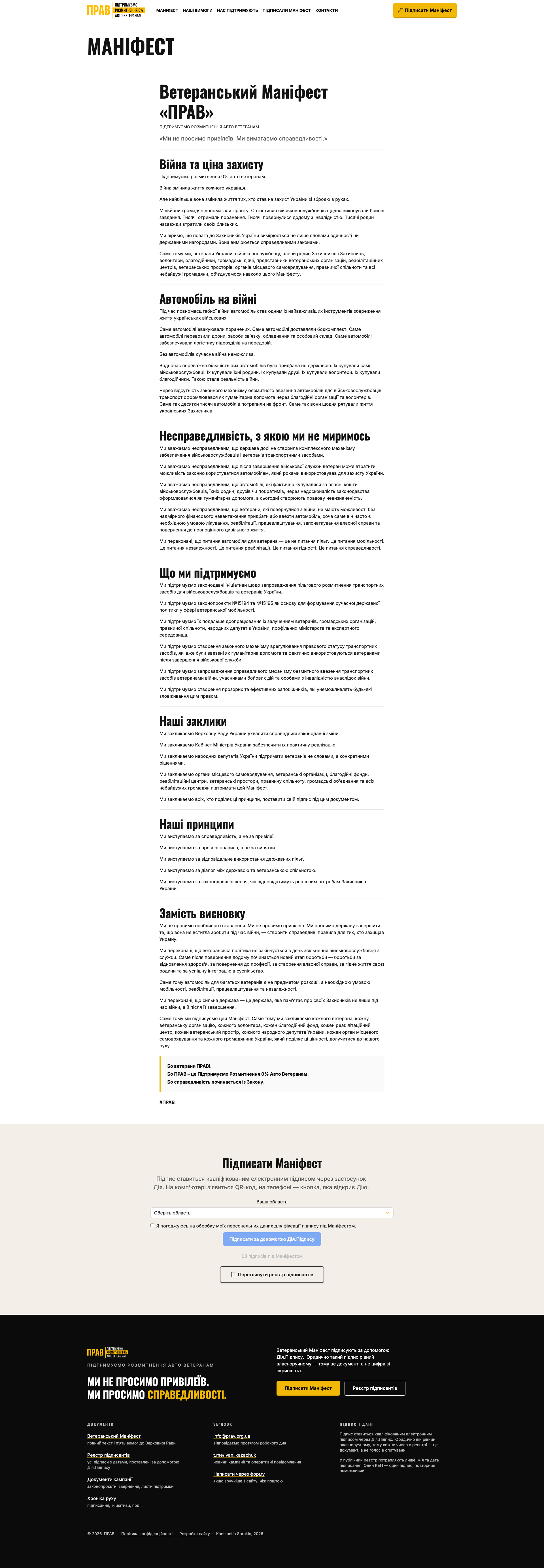
The manifesto is signed with Diia.Signature, Ukraine’s qualified electronic signature: a QR code on a desktop, a button that opens the app on a phone. In law that signature is equal to one made by hand, so what the register holds is a document rather than a tally of clicks.
One certificate signs once and cannot sign again, which is the sentence that makes the number mean something. The signer picks their region and consents to the record before signing; only a name and a date ever reach the public list.
None of that exists for WordPress, so it was written: KS Diia Sign, a plugin of its own, described on its own page.
A register that keeps itself
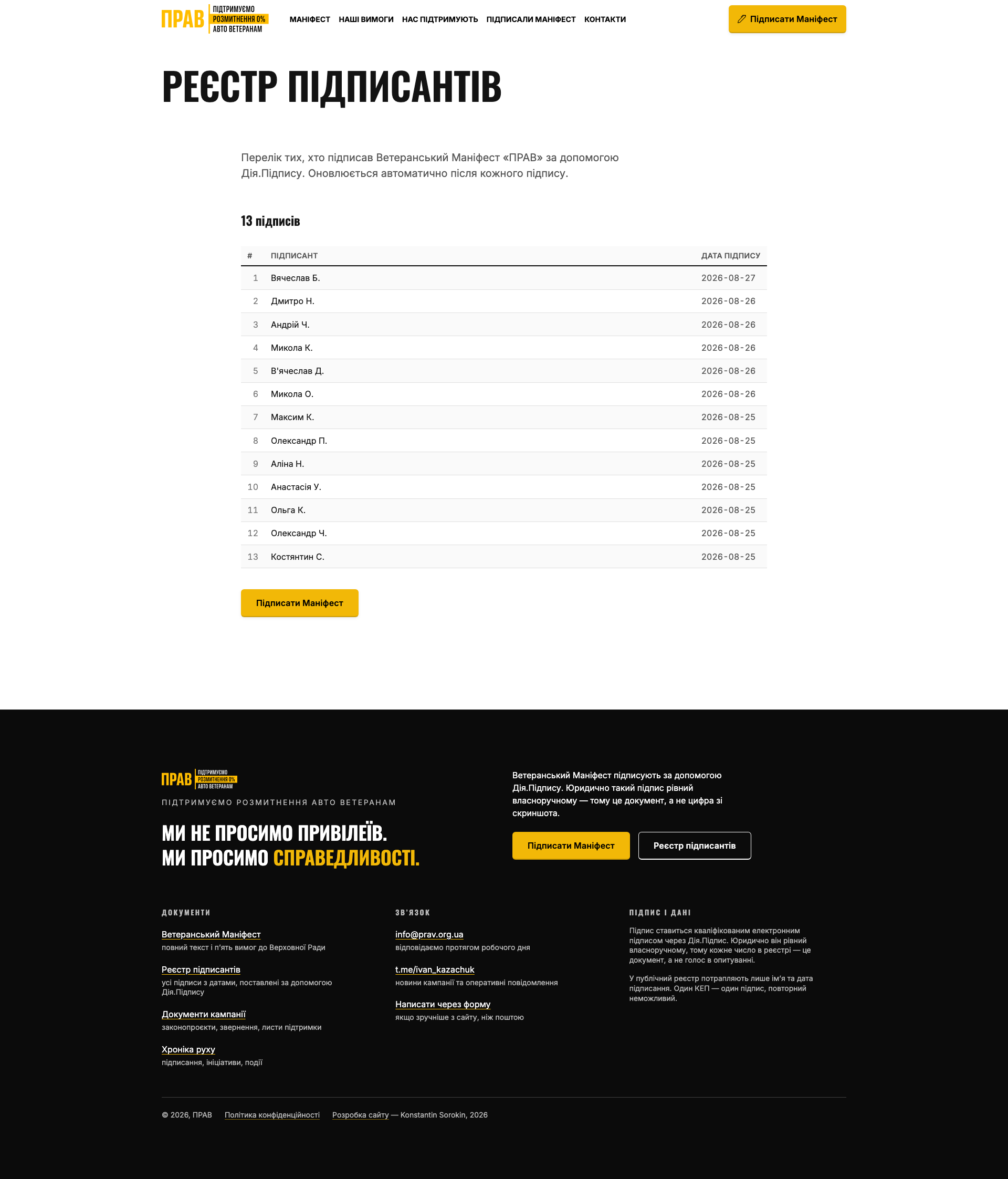
Every signature appears in a public register with the date it was made, updated after each one rather than compiled by somebody on a Friday. Nobody edits it, which is the point: a list that a person maintains is a list a person can be asked to adjust.
Beside it the support is counted by kind — citizens, veteran organisations, charitable funds, rehabilitation centres, local councils, members of parliament — because a demand made to parliament is read differently depending on who is standing behind it. A map of the oblasts carries the same figures geographically.
The legal case, in one place
Draft laws 15194 and 15195 sit on the site in full — the text, the explanatory note and the comparative table for each — beside letters of support, recommended amendments and analytical papers. Each is dated and filed under its kind, and each can be downloaded.
A movement that argues from documents is answered on documents. The library is what lets a deputy’s office, a journalist or a signatory check the claim rather than take it, and it is why the section exists at all instead of a page of bullet points.
Five demands, written down
Zero customs for veterans of the war, for participants in combat and for those disabled by it. The same right for serving soldiers. A lawful mechanism for the vehicles brought in as humanitarian aid and still in use after discharge. Rules that are transparent and identical for everyone. And safeguards, written in, that make the right impossible to abuse.
The manifesto states them as a single text rather than a list of asks, and the site publishes it whole — so that what is being signed is visible before it is signed.
Who is standing there
Veteran organisations, charitable funds, rehabilitation centres, city and oblast councils and individual deputies each get a page of their own rather than a logo in a strip, so support is a statement somebody signed rather than a mark that appeared overnight.
Alongside them the site carries the movement’s chronicle — the round tables, the initiatives, the coverage — and veterans’ own accounts of what a car actually decides in a life after service.
How it is built
WordPress on the same theme this portfolio runs on, with two plugins written for the job. One holds the document library: its kinds, dates and files are content the movement edits itself, not markup somebody has to be asked for.
The other is the signature, and it is the reason this site took as long as it did. The document has to be hashed, the state has to be asked for a one-time link, the signed container has to be caught coming back from the signer’s phone, and Ukraine’s own cryptography exists in no PHP extension. That became KS Diia Sign.
KS Diia Sign — how the signature is done
The register, the counters by kind and the map stand on top of it. The site is in Ukrainian, the language of everyone it is addressed to and everyone it is addressed at.
Ролі
Design, Development
Konstantin Sorokin
Виконано
- WordPress build on a custom theme
- Signing through Diia.Signature: one qualified certificate, one signature
- Public register of signatories, written on each signature rather than compiled
- Support counted by kind, with a regional map of Ukraine
- Document library: bills, explanatory notes, comparative tables, letters of support
- Supporters, movement chronicle and veteran stories as content the movement edits